
Maybe an officer pulled you over on the 401 near Yonge for doing 30 over, or you rolled through a stop sign in Scarborough with an officer parked around the corner. Now you’re holding a paper that doesn’t explain much. It’s an offence notice, and paying it is only one of four ways to respond. The other three can lead to very different results for your record, so it helps to know how each one plays out before you choose.
The First Fifteen Days Matter More Than You Think
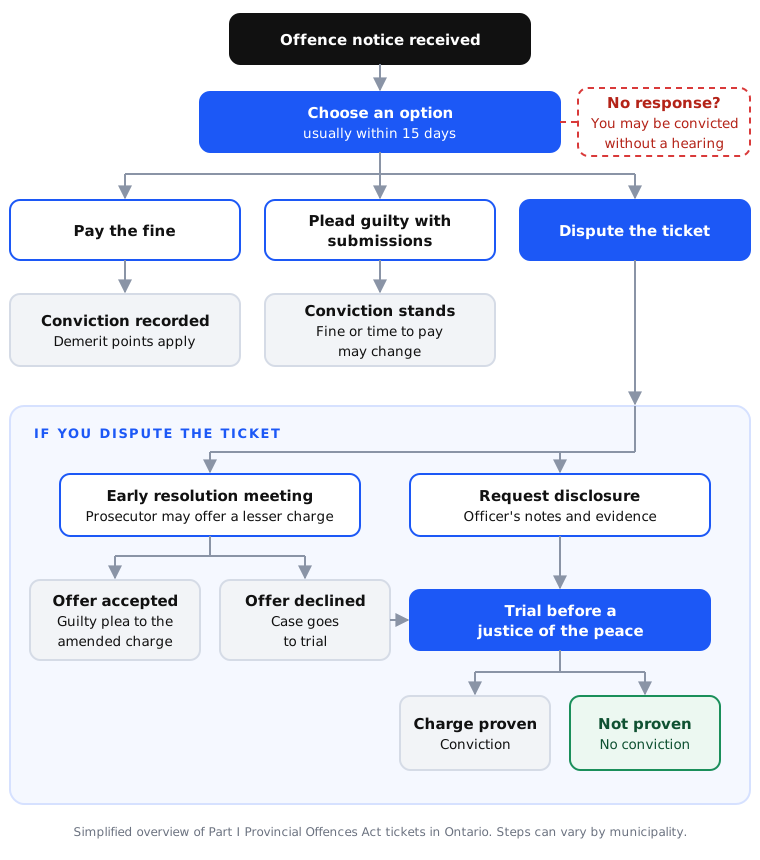
Nearly every ticket handed out at the roadside in Ontario is a Part I offence notice under the Provincial Offences Act. Your options are printed on the back. Generally, you have fifteen days from the day you receive it to pick one. Let that window close and the court can treat you as not disputing the charge. You can then be convicted without a hearing, the fine comes due with costs added, and any demerit points land on your record without anyone hearing your side.
A ticket is an accusation, not a conviction. Until you choose to pay it, the prosecution still has to prove its case.
None of the options locks you into a final outcome. Missing the deadline is much harder to undo, so compare the four routes before the two weeks run out.
| Option | What happens next | Effect on your record | Makes sense when |
|---|---|---|---|
| Pay the fine | Paying counts as a guilty plea | Conviction, plus any points | A zero-point ticket on an otherwise clean record |
| Plead guilty with submissions | You speak to a justice of the peace about the penalty | Still a conviction, but the fine or payment date can change | You accept the charge but money is tight |
| Early resolution meeting | You discuss the charge with a prosecutor | Depends on what you agree to | You’d accept a lesser charge with fewer points |
| Trial | The prosecution has to prove the charge | No conviction unless it’s proven | You have a real defence, or a lot to lose |
Early Resolution or Trial: Choosing Your Path
If you don’t simply pay, you reach a fork in the road. In Toronto and many other Ontario municipalities, you can ask for an early resolution meeting or go straight to trial. Both start from the same decision, but they feel nothing alike.
Inside an early resolution meeting
Think of it as a negotiation, not a hearing. You sit down with a municipal prosecutor, in person or by video, and talk about the charge. The prosecutor may offer to amend it. A speeding ticket, for instance, might be reduced to a lower speed with fewer points, or none. If you take the offer, you plead guilty to the amended charge in front of a justice of the peace, often the same day. If not, you can still ask for a trial.
What a trial looks like
A trial is a different animal. The officer is normally the key witness, and the prosecutor has to prove the offence beyond a reasonable doubt. Before your date, request disclosure: usually the officer’s notes and other evidence the prosecution will use. Read it line by line. Notes written long after the stop, no mention of where the officer was positioned, a speed reading with nothing about how the device was tested: details like these can matter. Delay matters too: under the Supreme Court of Canada’s 2016 decision in R. v. Jordan, provincial court cases that run past eighteen months can be stayed, with some exceptions.
What Is Really at Stake for Your Record
The amount printed on the ticket is often the cheapest part. If you hold a full licence, demerit points stay on your record for two years from the offence date. Reach two to eight points and you may get a warning letter. At nine to fourteen you may be called in for an interview, and at fifteen your licence is suspended for thirty days. Insurers often look back about three years, so one conviction can follow you through several renewals.
| Offence | Demerit points | Worth knowing |
|---|---|---|
| Careless driving | 6 | Fines can be steep, and jail is possible in serious cases |
| Speeding 30 to 49 km/h over the limit | 4 | Go much faster and it can become a stunt driving charge |
| Failing to stop for a red light | 3 | Camera tickets go to the vehicle owner and carry no points |
| Disobeying a stop sign | 3 | Often turns on whether the stop was full and complete |
| Driver not wearing a seatbelt | 2 | Drivers can also be charged when young passengers aren’t buckled |
Points stack up quietly. A stop sign ticket in the spring and a 30-over in the fall would leave a fully licensed driver at seven points, one more conviction away from the interview range. Your insurer sees both.
Getting Ready Before Your Court Date
Months from now, you won’t remember whether a hedge was hiding the stop sign or which lane you were in. Write it down now and keep everything in one place.
- The original offence notice and any later court mail
- Your own written notes about the stop, made as soon as possible
- Photos of the location, signs, road markings and sight lines
- Dashcam footage or phone video, saved in its original format
- Names and contact details of any passengers or witnesses
- A copy of your driving record and your insurance renewal date
When disclosure arrives, read it next to your own notes. Do the time, place and weather match your memory? Does the officer say exactly where they were when they saw the offence? One small inconsistency rarely wins a case on its own, but it can change how you approach the prosecutor.
The best time to think about a ticket is the week you receive it, not the week before your court date.
When It Makes Sense to Bring In a Paralegal
Plenty of drivers handle a minor ticket alone, and for a zero- or two-point charge that’s often sensible. Licensed paralegals in Ontario are regulated by the Law Society of Ontario and can represent you on provincial offences like these. Consider calling one if any of these apply.
- The charge carries four or more demerit points
- You already have points or recent convictions on your record
- You drive for work or hold a commercial licence
- The charge is careless driving or stunt driving
- You cannot attend court dates because of work or travel
- The disclosure raises questions you are not sure how to use
A paralegal can obtain and review the disclosure, speak to the prosecutor and appear in court so you don’t have to take a day off. They can also tell you plainly what each option means for your licence and premiums before you plead.
A ticket doesn’t have to end with a payment you regret six months later, when the insurance renewal arrives. Know your deadline, understand how early resolution differs from a trial, and look at the points before you look at the fine. If you’re still unsure which way to go, a short conversation with a licensed paralegal can usually settle it.